Showing posts with label science. Show all posts

Friday, October 7, 2011

Thought du jour - 7 October 2011


"I suppose the philosophically inclined can argue that science requires a sort of faith, but hardly the kind that governs religious thought. Personally, I've never understood the perceived need to wed science and religion. Politically expedient? Sure. But it's fundamentally dishonest, both to scientists and theologians." - Mac Tonnies

Saturday, September 17, 2011

Thought du jour - 17 September 2011


"I myself believe that there will one day be time travel because when we find that something isn't forbidden by the over-arching laws of physics we usually eventually find a technological way of doing it." - David Deutsch

Tuesday, August 16, 2011

Carl Sagan - Pale Blue Dot


Carl Sagan puts our world, and our lives, and our history, and our future, in perspective.

Paul Kimball

Friday, August 12, 2011

Everything... and Nothing

I heartily recommend this excellent two-part documentary series from the BBC about the universe, our attempts over the centuries to understand it, and our place in it.


Presented by Professor Jim Al-Khalili, Professor of Theoretical Physics and Chair in the Public Engagement in Science at the University of Surrey, the two films, epic in scope and often wonderfully surreal in style, take the viewer on a profound exploration of the true size and shape of the universe, and delve into the amazing science behind apparent nothingness.

Top notch filmmaking - a tone poem about both the wonders and the never-ending mysteries of existence.

Paul Kimball

"Thought" du jour - 12 August 2011


"The weight of the science indicates that if there's any human behaviour involved, it's a modest amount." - Tim Pawlenty

Pawlenty is speaking about climate change. Like many Americans who clearly skipped high school science, Pawlenty isn't convinced that anthropogenic climate change is real, and he appears to be genuinely sincere in his ignorance, given that he also has a soft spot for teaching intelligent design in public schools as if it were on an equal scientific footing with evolution. Alas, sincerity in the service of stupidity is not a virtue.

Sadly, Pawlenty isn't some outlier in the Republican Party on this issue. Indeed, he represents what passes for the "mainstream" within the Party these days. Rather than tell the truth to the American people, they continue to peddle what the oil industry lobbyists pay them to say - that there's nothing to worry about. I could quote scientific report after scientific report that shows Pawlenty is about as wrong as you can be on  this, but I figured I'd let one of wittiest political pundits provide some perspective.

Bill Maher, the floor is yours.


His best line?

"These people are so stupid, they make me question evolution."


None of the evidence makes any difference to Tim Pawlenty and the other Republicans, of course, a fact which should make a difference to the American people, who need honest leaders who tell them the truth, even when it's an inconvenient truth.

Paul Kimball

Wednesday, July 20, 2011

"Dr." John Cleese on the "All-Knowingness" of Man


Sometimes, brilliant philosophers come in the most unexpected packages.

We should always be conscious of the fact that there are a great many things about our universe, and ourselves, that we haven’t even begun to understand yet.  This is the fundamental flaw in the thinking of atheists, who maintain that they "know" there isn't a God, a proposition that is as unsupportable as that of the true believers, who claim to "know" that there is a God. To close ourselves off to the possibility that there might be more to heaven and earth than our current science can explain would be foolish, and unscientific.

I think that deep down, we're all agnostics. As death approaches, I think the true believer will always have doubt, and I think the hard-core atheist will always have hope - and neither of them will be entirely certain, for different reasons, of their "knowledge".

Paul Kimball

Thought du jour - 20 July 2011


"One of my motives for writing Against Method was to free people from the tyranny of philosophical obfuscators and abstract concepts such as “truth”, “reality”, or “objectivity”, which narrow people's vision and ways of being in the world. Formulating what I thought were my own attitude and convictions, I unfortunately ended up by introducing concepts of similar rigidity, such as “democracy”, “tradition”, or “relative truth”. Now that I am aware of it, I wonder how it happened. The urge to explain one's own ideas, not simply, not in a story, but by means of a “systematic account”, is powerful indeed." - Paul Feyerabend

Tuesday, July 19, 2011

Defending Science


The always amusing Bill Maher offers an overly simplistic but still funny defence of science, and scientism.

Paul Kimball

Sunday, July 17, 2011

Hilary Putnam, Bryan Magee, and The Philosophy of Science


A fascinating conversation between Bryan Magee, one of the great popularizers of philosophy, and Hilary Putnam, one of the great philosophers of the last fifty years, about the philosophy of science.

Paul Kimball

Thursday, July 14, 2011

Saving Science from the Cult of Scientism


The modern cult of science has enshrined the "scientific method" as their foundational principle, in much the same way that Christians look to Jesus on the cross, and all that it implies for them.

But method supremacy over subjective thinking which emphasizes context and meaning is a tragic mistake, and one which was the central target of the critique of modern science offered by philosopher Paul Feyerabend.

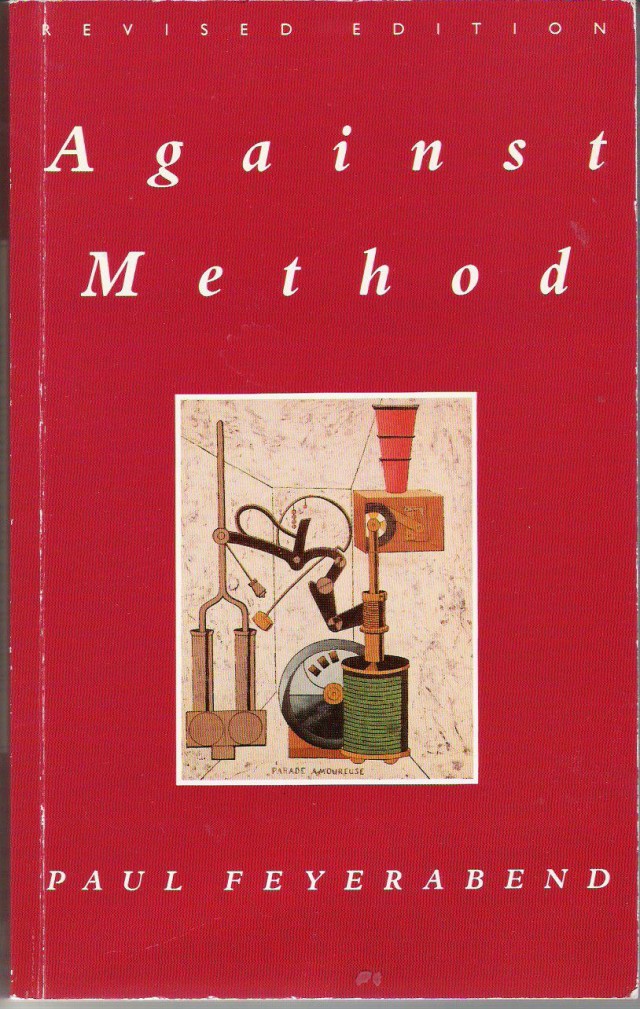
People interested in moving forward into the 21st century, and new knowledge and discoveries, should acquaint themselves with Feyerabend's work - in particular, his classic treatise Against Method: Outline of an Anarchistic Theory of Knowledge.

An excerpt:
For is it not possible that science as we know it today, or a "search for the truth" in the style of traditional philosophy, will create a monster? Is it not possible that an objective approach that frowns upon personal connections between the entities examined will harm people, turn them into miserable, unfriendly, self-righteous mechanisms without charm or humour? "Is it not possible," asks Kierkegaard, "that my activity as an objective [or critico-rational] observer of nature will weaken my strength as a human being?" I suspect the answer to many of these questions is affirmative and I believe that a reform of the sciences that makes them more anarchic and more subjective (in Kierkegaard's sense) is urgently needed.
Feyerabend called for a separation of state and science, in much the same way that we have long had a separation of state and religion in the West. In doing so, he is spot on. The institutionalization of science, and the resulting rigidity of thought, has done much to impede what should have been even greater progress for humanity by now, in the same way that the institutionalization of spirituality and faith throughout human history has led to rigidity in belief, and a lack of knowledge.


Feyerabend wasn't "anti-science" - far from it. He was an articulate, thoughtful and passionate voice calling out for a revitalization and reform of science, in a way that would be accessible to everyone, and that would recognize the strengths of science, and its limitations. It is a science that will no longer just speak to people; rather, it will be of the people, and in doing so encourage greater and more widespread knowledge.
The way towards this aim is clear. A science that insists on possessing the only correct method and the only acceptable results is ideology and must be separated from the state, and especially from the process of education. One may teach it, but only to those who have decided to make this particular superstition their own. On the other hand, a science that has dropped such totalitarian pretensions is no longer independent and self-contained, and it can be taught in many different combinations (myth and modern cosmology might be one such combination)... Scientists will of course participate in governmental decisions, for everyone participates in such decisions. But they will not be given overriding authority. It is the vote of everyone concerned that decides fundamental issues such as the teaching methods used, or the truth of basic beliefs such as the theory of evolution, or the quantum theory, and not the authority of big-shots hiding behind a non-existing methodology. There is no need to fear that such a way of arranging society will lead to undesirable results. Science itself uses the method of ballot, discussion, vote, though without a clear grasp of its mechanism, and in a heavily biased way. But the rationality of our beliefs will certainly be considerably increased.
You can find a short excerpt from Feyerabend's Against Method here.

We ignore his wisdom, particularly his central thesis that science is not one thing but rather many, at our peril.

Paul Kimball