"Consciousness is a potential technology; we are exquisite machines, nothing less than sentient patterns. As such, there's no convincing technical reason we can't eventually upload ourselves into matrices of our design and choosing. It's likely the phenomenon we casually call "intelligence" will cease to be strictly biological as we begin to merge with our machines more meaningfully and intimately." - Mac Tonnies
"A true pilot must of necessity pay attention to the seasons, the heavens, the stars, the winds, and everything proper to the craft if he is really to rule a ship." - Plato
Showing posts with label consciousness. Show all posts
Thursday, September 15, 2011
Tuesday, July 19, 2011
The Visions of William Blake and the Prison of the Mind
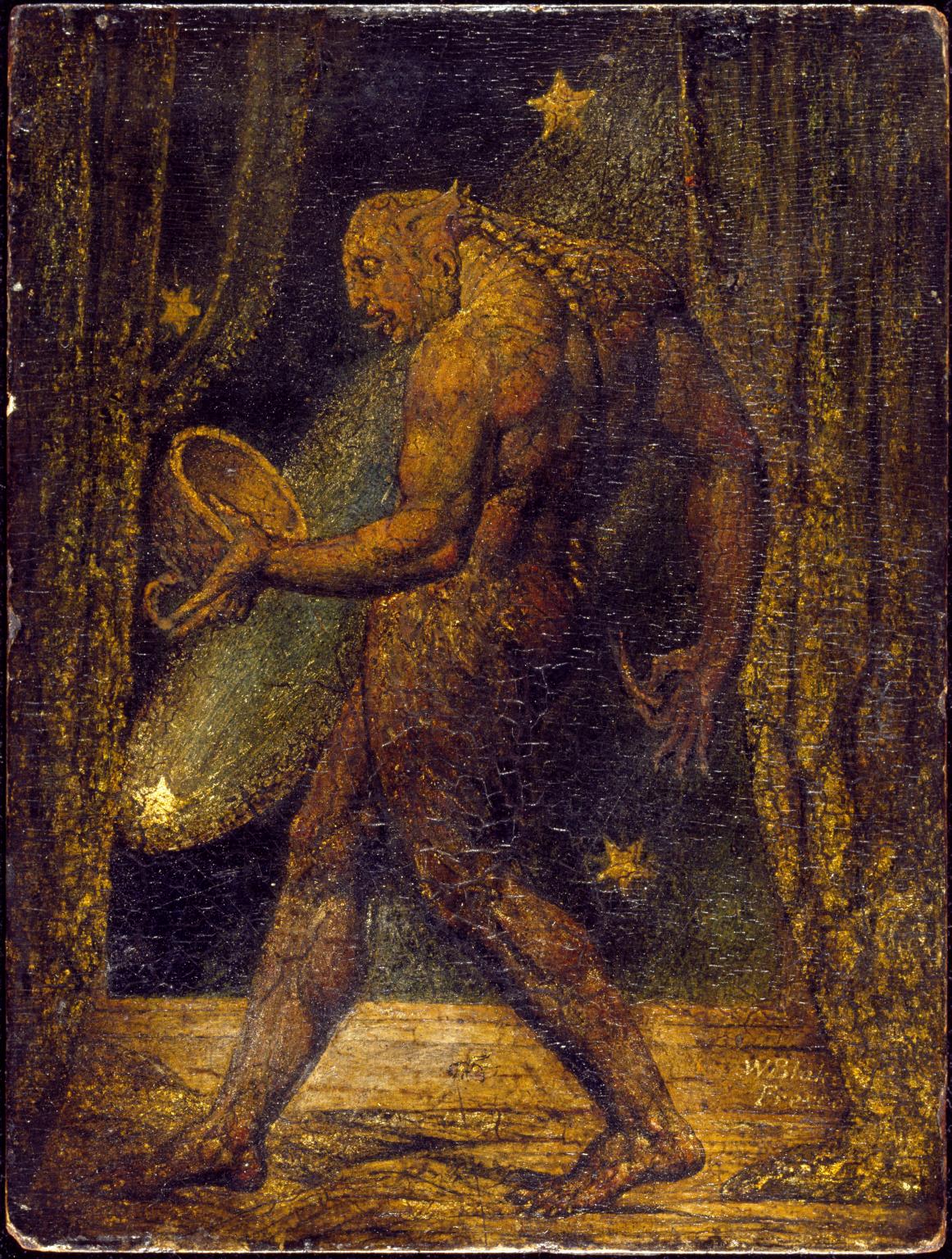
| William Blake's "The Ghost of a Flea" |
Astrologer and artist John Varley reported that his friend William Blake, who had experienced visions since his childhood, once had a vision of a ghost of a flea at a seance the two held in 1819. According to Varley:
As I was anxious to make the most correct investigation in my power, of the truth of these visions, on hearing of this spiritual apparition of a Flea, I asked him if he could draw for me the resemblance of what he saw: he instantly said, 'I see him now before me.' I therefore gave him paper and a pencil with which he drew the portrait... I felt convinced by his mode of proceeding, that he had a real image before him, for he left off, and began on another part of the paper, to make a separate drawing of the mouth of the Flea, which the spirit having opened, he was prevented from proceeding with the first sketch, till he had closed it.
I highly recommend this New York Times article from 1910 about Blake, his visions and the art that he created as a result. As the Times notes, "Whatever guess we make at the mighty puzzle of this power of vision, one thing is certain. Blake would have been a pale and ineffectual artist without it, and with it he contributed a poignant and enduring force to art."
One can only wonder what kind of diagnosis (and then treatment) a psychiatrist would make today were he confronted with someone like Blake, and the visions that he described. Fortunately, Blake lived in a time well before our modern world of corporatized and commercialized conformity, and was therefore able to use his visions - whatever might have caused them - as the inspiration for his art, his poetry and his philosophy, all work that remains hugely influential to this day.
If there is an "other" intelligence more advanced than our own which interacts with us, whether we call it God or something else, then I suspect that this is how it communicates with us - through visions. If this is the case, then I believe that we would all have the ability to receive that communication, in some form or another, but that the vast majority of us would not have the willingness to access that ability, largely because we're afraid of what it might represent, namely a loss of control. We want to "fit in" to society as it is structured around us (the ultimate control mechanism), but by fitting in we may be missing out on something far more important, and meaningful - the ability to truly be free.
Franklin Roosevelt hit the proverbial nail on the head when he commented that "men are not prisoners of fate, but prisoners of their own minds". Never has that been more true than it is today, when it should be the exact opposite given our technological advances, which have placed within our reach the means to expand not just our knowledge, but our understanding. But maybe that's the nature of the human condition - like the smart but lazy kid we all probably knew in high school, as a species we're happy to just coast through this life, getting by and doing okay, but in the end falling far short of our true potential.
Paul Kimball
Saturday, July 16, 2011
Heidegger's "Being and Time"
An excellent synopsis of Martin Heidegger's seminal work Being and Time by Holy Cross professor Lawrence Cahoone.
Paul Kimball
Wednesday, July 13, 2011
Social Media and Evolving Consciousness
Earlier today I speculated about the problems with what I see as a growing "surveillance society", where people are willing - indeed, eager - to surrender their privacy in order to achieve some false sense of belonging.
That's not alarmist hyperbole, in my opinion - just an observation, upon which I placed at least a couple of caveats.
But for every yin there is a yang.
Social media / networking also has the potential to lead to something wonderful - an empathic society.
I think the possibility exists that as we move further along in terms of technological development, which will enable us to share more of ourselves with each other, we may also move further along in terms of empathic development, to the point that our individualistic "sense of identity" could be broadened to a much more communal outlook.
It really comes down to a question of human nature, I suppose. The "surveillance society" of which I wrote is shallow, and dangerous, and at the moment all too real. But there is also a very real opportunity here, where eventually something deeper and more lasting will emerge that will truly change the way we view ourselves, and each other, for the better.
Accordingly, while we should be cautious in our use of the new social media, as is the case with any new technology, that doesn't mean that we should reject it. Indeed, we should embrace it, but for the right reason - to achieve meaningful communication with each other, and through that a greater understanding of who we are, both as individuals, and as a society.
Paul Kimball
Subscribe to:
Posts (Atom)